

Best 10 cold email strategies for 2026: A complete guide
The 10 cold email strategies that actually work in 2026
- Cold email still delivers massive ROI, but only when it’s intent-based and personalized.
- Spray-and-pray is dead. Modern cold email targets prospects already showing buying signals 🔍
- Intent beats demographics. Funding rounds, hiring signals, tech-stack changes, and competitor research drive higher conversions 📈
- Modern strategy = 6-step framework: intent → personalization → value-first copy → structured follow-ups → A/B testing → optimization loop 🔄
- Personalization must feel real. Context > {{first_name}} tokens.
- 50–125 words wins. Short, problem-focused emails outperform long feature dumps.
- Subject lines (4–7 words) drive opens. Curiosity + relevance > clever tricks.
- Follow-ups matter. 55% of replies come after the first email.
- Deliverability is foundational. SPF, DKIM, DMARC, and warm-up protect inbox placement 📬
- Test relentlessly. Subject lines, CTAs, angles and let data decide.
Modern B2B cold email relies entirely on intent signals and precise targeting.
So if you want your cold email strategy for 2026 to actually work, focus on meaningful personalization, strategic follow-ups, and relentless testing, not mass blasting.
In this guide, we'll walk you through 10 proven cold email strategies for 2026 so you can transform your outreach from ignored messages to revenue-generating conversations.
Ready to see what works now?
Old-school vs. modern cold email
Cold email has changed a lot throughout the years. But the contrast between outdated approaches and modern, data-driven methods couldn't be more stark.
The fundamental shift: Old-school cold email casts a wide net hoping to catch anything, while modern intent-based cold email uses precision targeting to reach prospects already showing buying signals.
Here's how they stack up:
The difference?
Old-school approaches say: "Here's what we sell, want to buy it?"
Modern approaches say: "Based on what you're currently doing, I thought you might find this valuable..."
That's exactly why we love using Clay for lead generation. Instead of guessing who might be interested, we track actual buying signals: pricing page visits, recent funding rounds, competitor engagement, and reach out when prospects are already in buying mode.
How to build a cold email strategy that actually works in 2026
You can think of your cold outreach strategy as building a house. Without a blueprint, you might create something, but will it really hold up? Skip the foundation, and everything eventually collapses, usually when you need it most.
The same applies to your cold email strategy.
You need a solid framework before sending a single message. The most successful cold email strategies follow this basic structure:
- Step 1: Identify intent signals that indicate buying readiness
- Step 2: Research and personalize messages for each prospect
- Step 3: Craft compelling subject lines and opening lines
- Step 4: Deliver value before asking for anything
- Step 5: Follow up strategically with varied content
- Step 6: Test, measure, and optimize continuously
If you're scratching your head about the sweet spot for daily sending volume, we've got you covered with our guide on how many cold emails you can actually send per day without destroying your sender reputation.
As of 2026, a good cold email conversion rate typically falls between 1% and 5%, with rates above 5% indicating exceptionally well-targeted campaigns.
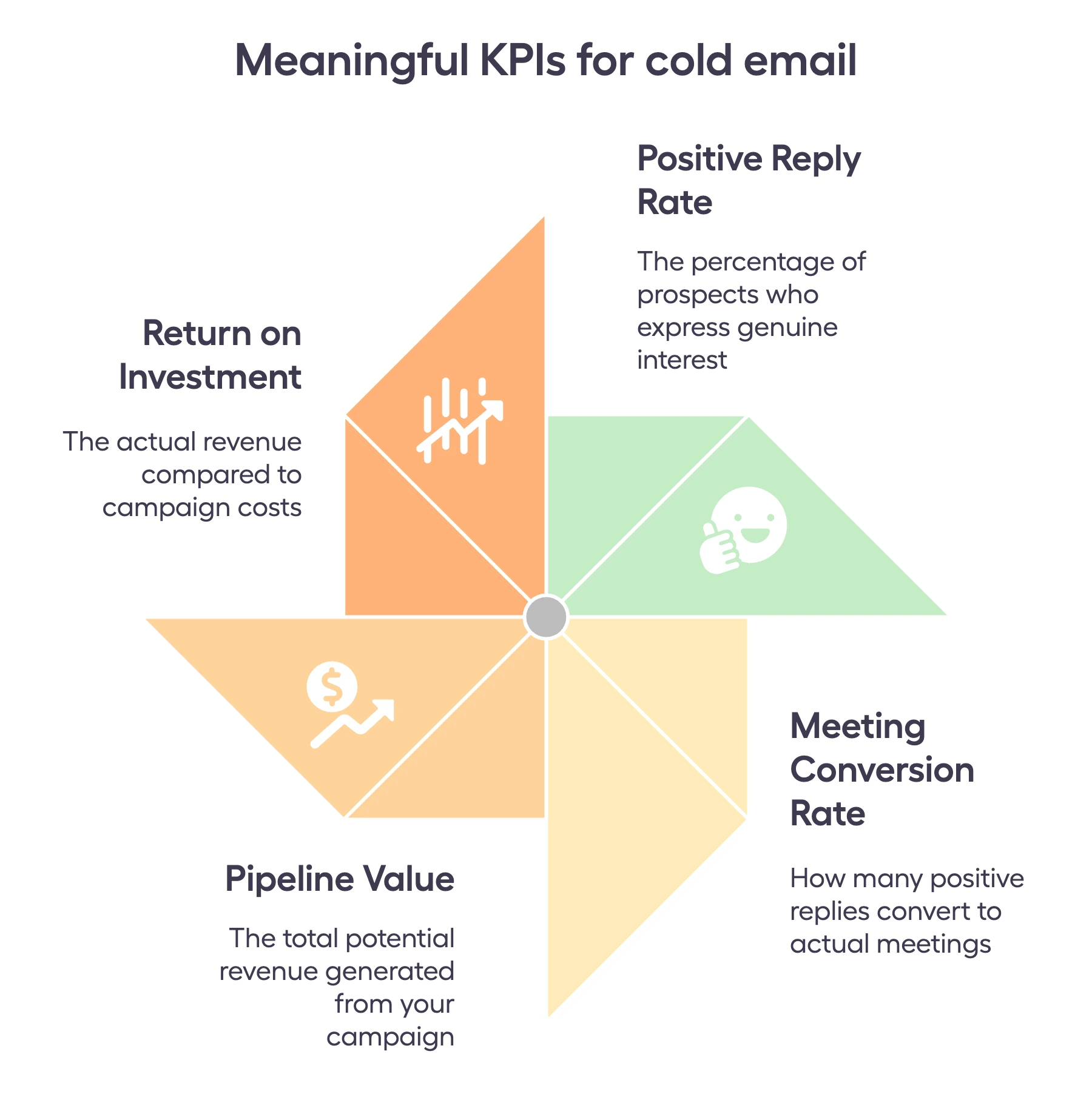
When setting goals for your cold email campaigns, avoid vanity metrics like "we sent 5,000 emails this month!". Instead, focus on what actually impacts your business:
Get your cold email foundation right
If your technical setup is broken, no strategy will save your cold emails.
Here's the thing most people get wrong: they obsess over the perfect subject line or the most clever opening, but completely ignore the foundation.
Technical requirements you can't ignore:
Your team setup matters too. The most effective cold email operations have clear roles:
- Data analysts finding the right prospects
- Content specialists crafting compelling messages
- Deliverability experts for technical compliance
- Sales development reps handling responses and follow-ups
And if you're thinking 'this all sounds complicated, can't someone just handle it for me?', the answer is yes. Our comparison of the best cold email infrastructure providers shows you exactly which ones are worth your money.


What metrics actually matter in cold email campaigns?
Now that you've got the foundation in place, let's talk about what actually tells you if your campaigns are working.
Not all metrics are created equal in the cold email world. While many marketers obsess over open rates (typically ranging from 40% to 60%), they can be misleading due to how email clients process tracking pixels, and we consider them a vanity metric.
What you should actually measure:
- Positive reply rate: This measures genuine interest, not just curiosity
- Response quality: Are replies asking meaningful questions or just saying "unsubscribe"?
- Meeting conversion: How many conversations turn into actual appointments?
- Revenue generated: The ultimate metric that justifies your efforts
Think of open rates as someone walking into your store. Great! But did they buy anything? That's what really counts.
The 10 cold email strategies top B2B teams use in 2026
Alright, enough theory. Let's get into the actual strategies that work in 2026.
Here's what we're gonna cover:
- Target people who actually want to hear from you
- Make each email feel like it was written just for them
- Craft subject lines people can't help but open
- Solve problems, don't just pitch
- When (and how) to follow up without being annoying
- Test everything (and let the data guide you)
- Show them you've helped others just like them
- Don't just email them - connect across channels
- Keep your emails landing in inboxes (not spam)
- Never stop improving your cold email approach
So let's dive into the strategies that separate the amateurs from the pros. And no, none of them involve writing "Just following up" seventeen times in a row.
Strategy #1: Target buyers already showing intent (not just any lead)
Imagine walking into a vegetarian restaurant trying to sell steaks. That's exactly what most cold email campaigns do.
Instead, find the people already shopping for what you're selling, which starts with building a quality lead list for cold emailing that's based on actual intent, not guesswork.
So how do you actually spot buying intent in 2026?
🔸 Step 1: Track website behavior: If someone's hitting your pricing page or checking out your demo page multiple times, they're not just browsing. They're evaluating.
🔸 Step 2: Monitor hiring signals: When a company posts jobs for roles that use your type of solution, they're literally preparing to buy something like yours.
🔸 Step 3: Watch for funding events: Fresh capital means fresh budgets and ambitious growth plans. Perfect timing to reach out.
🔸 Step 4: Notice content engagement: Prospects reading competitor comparisons or downloading industry reports? They're in research mode, which means they're close to making a decision.
🔸 Step 5: Leverage AI-powered intent data: The game has changed. Tools can now track everything from technographic changes to G2 review activity to podcast appearances. If someone's actively researching your space, you'll know.
Across our campaigns, we monitor over 100 intent signals (website visits, hiring posts, funding rounds, tech-stack shifts, leadership changes, competitor review activity) to pinpoint when a prospect is most receptive.
The objective isn't to mistake every trigger for an immediate buying decision, but to leverage real-time business changes as context for relevant, perfectly timed outreach.

Companies implementing intent-based targeting see 15-20% better conversion rates than those using traditional demographic-based targeting alone.
Strategy #2: Personalization at scale: Make each email feel like it was written just for them
Personalization at scale means making hundreds or thousands of emails feel individually crafted using data and automation, without sacrificing the human touch that drives responses.
But look, nobody wants to feel like "prospect #4,372" in your database. And personalization in 2026 goes way beyond "Hey {first_name}!" That's so 2015.
Here's what real personalization looks like:
Basic (yawn): "Hi John, hope you're doing well. I wanted to tell you about our software..."
Better (getting warmer): "Hi John, I noticed Manufacturing Monthly featured your factory expansion last week. Congratulations on the growth!"
Best (chef's kiss): "Hi John, I saw your LinkedIn post about reducing production bottlenecks at your Milwaukee facility. Given your focus on automated quality control, I thought you might be interested in how we helped three other mid-sized manufacturers solve similar issues..."
But it's not just about what you mention, it's about who you're talking to.
A message that gets a CFO excited will likely bore a CTO to tears, and what resonates with an SDR leader or RevOps manager is completely different from what a VP of Sales cares about:
Bottom line: Use data to personalize at scale, but make every email feel like you actually took the time to understand their world. Because that's exactly what gets responses.
Strategy #3: Craft subject lines people can't help but open
A good cold email subject line in 2026 is short (4-7 words), specific to the recipient's situation, and creates just enough curiosity to earn the open, without resorting to clickbait or deception.
Your subject line has exactly one job: get the email opened. That's it. Not to sell, not to explain, just to create enough curiosity that the recipient can't help but click.
And before you ask: no, those old tricks don't work anymore.
You know the ones: fake "Re:" and "Fwd:" prefixes that make your email look like part of an existing conversation. Gmail and other providers have gotten way smarter about detecting this stuff. Use these tactics now and you're not being clever, you're tanking your deliverability and training spam filters to hate you.
The psychology behind effective subject lines taps into fundamental human triggers:
🔸 Trigger #1: Curiosity gap: Create just enough intrigue to make them want to know more
🔸 Trigger #2: Self-interest: Clearly indicate what's in it for them
🔸 Trigger #3: FOMO: Suggest they might miss valuable information by not opening
🔸 Trigger #4: Relevance: Connect to their current priorities
🔸 Trigger #5: Urgency: Why now? (But avoid fake urgency)
🔸 Trigger #6: Recognition: Make it feel like you understand their specific situation
.webp)

Always test at least two different subject lines with every campaign. Let data, not your gut, decide what works!
And test substantively different approaches rather than minor variations:
✅ "Case study: How we solved X" vs. "Question about your approach to X"
❌ "How to improve X" vs. "How to enhance X"
Let the data tell you what works. Your gut feeling is probably wrong.
Your emails are landing in the inbox but nobody's opening them? They're probably hitting the Promotions tab. Check out our definitive guide on avoiding Gmail Promotions tab with 12 proven tactics that keep you in Primary where people actually read.
Strategy #4: Solve problems, don't just pitch
Nobody wakes up excited to read sales pitches. But everyone loves solutions to their problems. Structure your cold emails to show you understand their pain before offering relief.
High-converting cold emails typically follow this structure:
- Personalized opener that proves you've done your research
- Problem identification that resonates with their specific situation
- Problem agitation that highlights consequences of not solving it
- Solution introduction that shows how you can help
- Simple call to action that makes responding easy
The sweet spot for cold email length? 50-125 words. That's roughly 3-4 short paragraphs. Anything longer and you're asking for too much attention from someone who doesn't know you yet.
Don’t try to explain everything you do in one email. The goal is to make the prospect understand why a conversation might be relevant to them and give them an easy reason to respond.
Wondering what actually goes into a cold email that gets responses, we wrote the ultimate guide on how to write the best cold email, covering everything from subject lines to CTAs that convert.
Strategy #5: How many follow-ups before you're just being annoying?
Ever had a salesperson follow up so persistently you considered changing your name and moving to another country? Don't be that person. But also don't give up after one try.
.webp)
Each follow-up should offer something new: a different perspective, additional information, or a fresh insight. Nobody wants to see "just following up" in their inbox for the fifth time.
Instead, try sharing a relevant case study they might find interesting, offering a helpful resource or template they can actually use, highlighting an industry trend that affects them, or suggesting a different person on their team who might care.
When should you stop following up?
After three follow-ups (4 total emails), it's time to move on. If they haven't responded by then, they're either not interested, not the right person, or dealing with something more urgent.
Circle back in a few months when their situation might have changed.
Strategy #6: A/B test your cold emails and let the data decide
Think you know what works in cold email? Awesome!
Now test it anyway and make sure you're using a good cold email software to actually track what's working and what's tanking.
Intuition is a great starting point, but performance data is what drives scale. Outreach dynamics shift quickly. For example, a high-performing subject line last month can easily drop off this month without real-time tracking to catch the decay.
What should you test? Pretty much everything:
- Subject lines: The gateway to your email being read
- Opening lines: The difference between continued reading and instant deletion
- Call to action: Ask for a call, a reply, or something else?
- Send times: Tuesday morning or Thursday afternoon?
- Email length: Concise pitch or more detailed explanation?
The A/B testing framework that actually works:
- Step 1: Form clear hypotheses: "Subject lines that mention the prospect's competitor will generate higher open rates than those mentioning their industry trends"
- Step 2: Ensure similar segments: Compare apples to apples by testing with similar audience groups
- Step 3: Adequate sample size: Aim for at least 100 recipients per variation for statistical significance
- Step 4: Single Variable: Test one element at a time. Change both subject line AND body copy, and you won't know which one made the difference.
- Step 5: Measure Results: Track meaningful metrics. Replies matter way more than opens.

We once boosted a client’s response rate just by tweaking their CTA. Instead of asking, "Can we schedule a call?", we switched it to "Is this a priority for you right now?"
Strategy #7: Use social proof in cold emails (without overdoing it)
Relevant social proof remains one of the fastest ways to overcome buyer skepticism.
In the context of cold emails, it typically falls into three primary categories:
- Testimonials from similar companies (bonus points if they're in the same industry)
- Case studies showing measurable results (with actual numbers, not vague claims)
- Data-driven metrics like "increased conversions by 37%" (specific numbers outperform rounded ones)
- Name-drops of recognizable clients in their industry
When including case studies, keep them micro-sized. Example:
We helped [Similar Company] increase their [relevant metric] by [specific percentage] in just [timeframe] by solving their [specific problem].
Strategy #8: Multi-channel outreach: Don't just email them, connect everywhere
If your prospect only sees your name in their inbox, you're missing huge opportunities. The magic happens when they see you across multiple channels, creating what marketers call the "surround sound effect."
Here's a brief multi-channel outreach flow:
- Step 1: View their LinkedIn profile (yes, they'll see you viewed it - that's the point)
- Step 2: Send a connection request with a brief, non-salesy note
- Step 3: Wait 1-2 days, then send your first email
- Step 4: Engage with their content - comment thoughtfully on their posts
- Step 5: Share relevant content that addresses their industry challenges
- Step 6: For high-value prospects, use personalized video messages
Here's how these channels work together:
- Email introduces your value proposition and opens the conversation
- LinkedIn builds personal connection and shows you're a real human
- Content sharing demonstrates expertise and keeps you top of mind
- Video adds a human touch that text alone can't match
80% of conversions happen after at least five touchpoints. This just goes to show how important it is to follow up strategically across different channels!
Strategy #9: Keep your emails landing in inboxes (not spam)
Writing the world's most persuasive email means nothing if it lands in the spam folder.
Cold email deliverability has become increasingly complex in 2026, but these basics will keep you safe:
.webp)
Managing your email domain reputation is also super important.
Start by using a separate domain or subdomain for cold outreach, and take your time warming up any new sending domains.
Keep an eye on your overall email sender reputation and aim for strong engagement metrics, that’s the key to making sure your emails actually get delivered.
A single spam complaint carries the weight of hundreds of positive engagements in the eyes of email providers. This is just one of the critical email deliverability issues that can tank your campaigns if you're not careful.
So handle unsubscribe requests immediately!
Not sure which warmup tool can handle multiple domains without breaking your budget? Our complete breakdown of the best email warmup tools covers everything from Instantly to Lemwarm to Mailreach - with honest pros and cons for each.
Strategy #10: How often should you update your cold outreach strategy in 2026?
Review your cold email performance weekly for tactical adjustments (what's working, what's tanking), monthly for strategic shifts (audience changes, new messaging angles), and quarterly for major pivots (completely new approaches or market repositioning).
Build these feedback loops into your process:
- Regular performance reviews: Weekly analysis of what's working and what's not
- Customer interview insights: Ask new customers what made them respond initially
- Lost opportunity feedback: Find out why some prospects engaged but didn't convert
- Competitive awareness: Keep tabs on what others in your space are doing
Deciding when to refine vs. when to pivot can be tricky, especially when you’re dealing with uncertainty or trying to figure out if your current strategy is still worth sticking with.
Here are some tips:
- Refine if: Your main ideas are working, but execution could use tweaks → Your positive reply rate is 3-5%, but meeting conversion is low → Engagement is steady, but you want to scale
- Pivot if: Core assumptions about your audience or messaging are off → Your positive reply rate drops below 2% for 3+ weeks → Engagement plateaus despite multiple refinements → You're targeting the wrong buyer persona entirely
- The decision tree: If engagement metrics drop 30%+ over 30 days → Pivot. If metrics are stable but not growing → Refine. If you're hitting targets → Keep optimizing incrementally.
For us, continuous campaign optimization is central to our methodology.
In short, we double down on the winning angles, cut what isn't working, and keep your pipeline consistently full of qualified leads.
Start sending better emails today
There you have it, the 10 best cold email strategies that actually work in 2026. Let's recap what we covered:
- Target people with buying intent - Stop spray and pray, start fishing where the fish are
- Personalize meaningfully - Go way beyond {first_name}
- Craft irresistible subject lines - Get them to actually open
- Solve problems, don't pitch - Lead with value, not features
- Follow up strategically - Persistence without being annoying
- Test relentlessly - Let data guide your decisions
- Leverage social proof - Show them you've done this before
- Go multi-channel - Email + LinkedIn + content = magic
- Protect your deliverability - None of this matters if you land in spam
Never stop improving - What works today won't work forever
Remember: the goal is to start valuable conversations with prospects who actually need what you offer. That's where the real results happen.
The difference between cold outreach that gets ignored and outreach that creates real business opportunities is rarely one perfect email. It's the result of getting the fundamentals right: who you contact, why you contact them, what you say, and how consistently you learn from the results.
Frequently asked questions
Definitely yes. When done right, cold email outperforms most other B2B channels. The key is to stop blasting generic messages to everyone. What works in 2026 is intent-based targeting and real personalization. Focus on prospects already showing buying signals, and cold email becomes your hottest lead source.
We recommend sending no more than 35-40 emails per day per email address to protect deliverability. For follow-ups, use this cadence: initial email, then follow up on days 3-4, 7-10, and 14. That's 1 initial email plus 3 follow-ups over 10-14 business days, enough persistence without being annoying.
Target at least 3-5% positive reply rate, even 3% can be acceptable with tough audiences. Anything below 2% for three weeks straight means it's time to pivot your strategy completely.
Use the Problem-Solution Framework: personalized hook + specific problem + consequence + relevant proof + low-friction CTA. Keep it 50-125 words, lead with their challenges (not your features), include social proof, and make responding stupid-easy. Test everything and let data guide your approach.
The sweet spot is 50-125 words, roughly 3-4 short paragraphs. Emails under 50 words feel abrupt; over 125 words lose attention. Research shows emails around 75-100 words get the highest response rates. Remember: you're starting a conversation, not explaining your entire product in one message.
Don’t miss these

Get your first lead this month
14 days to get started. 7 days to get your first lead on average.


